Medical Aid in Dying Nears Final Vote

Dr Varipapa Testifies in Legislative Hall

A legislative journey

The first attempt to pass medical aid in dying legislation in Delaware occurred back in 2015, and Rep. Paul Baumbach (D-Newark) has been persistently shepherding the measure through advancements and failures ever since.

This year, House Bill 140, also known as the Ron Silverio/Heather Block End of Life Options Law, named in honor of two advocates who died before its passage, has wound its way through the Delaware General Assembly. On Wednesday, the Senate Executive Committee advanced the bill to a Senate floor vote – it’s final step before heading to the desk of Gov. John Carney, where it’s future is uncertain.

The debate over physician-assisted suicide in the current legislative session has already seen some dramatic moments though, including its first approval by the House of Representatives in April. That vote was made possible in part by the vivid testimony from Middletown Republican Kevin Hensley, who changed his longstanding opposition after his own mother exercised the medically assisted suicide option last year in California, where it is already legal.

Just two weeks after her passing in April 2023, Hensley supported the measure through the House Health & Human Development Committee. Testifying through a choked-up voice, Hensley noted that he disagreed with her decision but came to understand that it was her choice to make.

Body mass index or BMI Falling out of favor

Body mass index was first developed in 1832 and has been the standard way to estimate a person’s body fat since the 1980s. The calculation, however, has come under increasing scrutiny in recent years.

One major critique of BMI is that it doesn’t look at how much of a person’s weight is fat, and where fat is distributed around the body. It also doesn’t take into account the other elements that make up a person’s body composition beyond fat, including muscle, bone, water and organs.

“Fat distribution and body composition can vary dramatically among different people with the same BMI,” Wenquan Niu, a professor at the Capital Institute of Pediatrics in Beijing, wrote in an email.

Because muscle is much denser than fat, BMI skews higher in people who are very muscular but have less body fat, like athletes https://www.nbcnews.com/health/health-news/bmi-flaws-body-roundness-index-better-rcna155898

Healthy diet, exercise, slow decline in Alzheimer’s

A healthy diet and consistent exercise may slow decline in some early-stage Alzheimer’s disease patients, according to research published Friday. 
The study, published in the journal Alzheimer’s Research and Therapy, found that patients in a group who implemented “intensive” lifestyle changes — like eating whole foods, exercising moderately and performing stress management techniques — saw their dementia symptoms stabilize. In the other group, patients who did not alter their habits found their thinking and memory continued to worsen https://thehill.com/policy/healthcare/4711200-diet-exercise-may-slow-decline-in-some-alzheimers-patients-study/

Over The Counter Hearing Aids

These WIRED-tested and audiologist-approved devices will help you hear sounds more clearly. Never miss out on a dinner conversation again.

“FOR THOSE WITH hearing challenges, there’d long been just one option for dealing with it: an expensive, bulky hearing aid prescribed by a doctor. That changed in 2022 when the US Food and Drug Administration approved over-the-counter hearing aid devices, giving consumers access to a vast and growing array of alternatives.

Today, there are more hearing aids than ever, and they come in all different shapes, sizes, and most importantly, prices. How does a $100 hearing aid compare to a $5,000 prescription device for treating mild to moderate hearing loss? We’ve been testing products for the past two years to answer that question.”

https://www.wired.com/gallery/best-hearing-aids/

A breakthrough in Alzheimer’s disease

A breakthrough in Alzheimer’s disease The promising potential of klotho

I have this dream that people might be able someday to benefit from klotho, this factor that naturally circulates in our body, that helps with longevity, that helps with other organ systems and enhances the brain.” —Dena Dubal

Dena Dubal is a physician-scientist and professor of neurology at UCSF whose work focuses on mechanisms of longevity and brain resilience. In this episode, Dena delves into the intricacies of the longevity factor klotho: its formation and distribution in the body, the factors such as stress and exercise that impact its levels, and its profound impact on cognitive function and overall brain health. Dena shares insights from exciting research in animal models showing the potential of klotho in treating neurodegenerative diseases as well as its broader implications for organ health and disease prevention. She concludes with an optimistic outlook for future research in humans and the potential of klotho for the prevention and treatment of Alzheimer’s disease.

#303 – A breakthrough in Alzheimer’s disease: the promising potential of klotho for brain health, cognitive decline, and as a therapeutic tool for Alzheimer’s disease | Dena Dubal, M.D., Ph.D.

Why Medicare Advantage is not an Advantage

Prior authorization issues and the quest for profits are major issues with many Medicare Advantage plans, as outlined in this article.

“Traditional Medicare rarely requires so-called prior authorization for services. But virtually all Medicare Advantage plans invoke it before agreeing to cover certain services, particularly those carrying high price tags, such as chemotherapy, hospital stays, nursing home care and home health.

“Most people come across this at some point if they stay in a Medicare Advantage plan,” said Jeannie Fuglesten Biniek, associate director of the program on Medicare policy at KFF, the nonprofit health policy research organization. After years of steep growth, more than half of Medicare beneficiaries are now enrolled in Advantage plans, which are administered by private insurance companies.”

Get Ready for Summer Heat Wave

This summer is slated to be a hot one, which means more risk to population health. Last summer, emergency room visits for heat-related illnesses reached an all-time high

The National Oceanic and Atmospheric Administration (NOAA) and CDC created a health risk score taking into account temperature, humidity, and other metrics that impact health. The risk score ranges daily from “No risk” to “Extreme” heat risk.

More here, from my favorite epidemiologist
https://yourlocalepidemiologist.substack.com/p/state-of-affairs-may-23

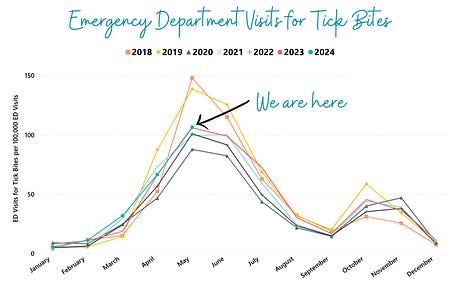
Tick Bite Season is Here

Warm weather and lush spring vegetation are perfect for ticks to multiply. Ticks carry multiple diseases, especially Lyme, which is endemic in Delaware. Lyme disease often causes flu-like symptoms if it gets systemic along with neurologic and cardiac complications, especially if it becomes chronic.

Protect yourself from ticks by using products containing DEET or picaridin, treating clothing and gear with permethrin (watch out for allergies to this stuff) and carefully checking for ticks after outdoor activities (may need to get near naked 🙂

More details from my favorite epidemiologist https://yourlocalepidemiologist.substack.com/p/state-of-affairs-may-23

Botox for Trigeminal Neuralgia

There is a growing body of evidence suggesting that Botox is a safe and effective treatment for trigeminal neuralgia.

Trigeminal neuralgia (TN) is a chronic facial pain disorder characterized by sudden, severe, electric shock-like pain in one or more branches of the trigeminal nerve. This condition is relatively rare, with about 4.3 new cases per 100,000 people each year in the US.

TN can significantly impact quality of life, often leading to higher rates of depression, anxiety, and sleep disorders compared to the general population. Common triggers like brushing teeth, chewing, and swallowing can be so painful that individuals may neglect oral hygiene, lose weight, become dehydrated, and develop anxiety about these activities. TN can be highly disabling, with up to 45% of sufferers missing daily activities for at least 15 days in six months, and over 50% experiencing severe anxiety and depression related to their pain.

Trigeminal Neuralgia Treatment

The first line of treatment for TN usually includes anticonvulsant medications such as carbamazepine, oxcarbazepine, lamotrigine, gabapentin, lacosamide, or the muscle relaxant baclofen. However, these drugs often have side effects like fatigue, cognitive issues, dizziness, tremors, and electrolyte imbalances, which can limit their use. For acute pain flares, treatments like infusion therapy and trigeminal nerve blocks are used.

Surgical options for classic TN include microvascular decompression, gamma knife radiosurgery, and balloon compression, but these come with concerns about tolerability, long-term efficacy, and safety.

Botox for Trigeminal Neuralgia Treatment

Botox, also known as OnabotulinumtoxinA, FDA-approved for chronic migraine, is used off-label by neurologists for TN. Small studies have shown that it can be a safe and effective treatment, particularly for those who cannot tolerate medications or are not candidates for surgery. This treatment has been shown to reduce pain intensity and attack frequency and improve quality of life compared to a placebo.

Speak with your CNMRI neurologist about this treatment if you are having break through facial pain from TN in spite of multiple medication trials.

https://practicalneurology.com/articles/2024-may-june/onabotulinumtoxina-for-trigeminal-neuralgia-treatment

When Is It Time to Stop Driving Because of a Neurologic Condition?

Getting loved ones who have memory and executive function problems to stop driving can be tricky. These recommendations may help.

“Because symptoms emerge at varying rates, every person needs to be assessed individually,” says Ergun Uc, MD, FAAN, director of the movement disorders division at University of Iowa Health Care in Iowa City. “Some people may retain the basic ability to operate a car but may become lost when driving or feel unsure when they have to make a decision quickly.”

Other problems that could develop include going too fast or too slow, getting confused by stop signs and traffic signals, and having difficulty changing lanes or making turns. If a driver starts getting into fender benders or receiving more traffic tickets than usual, that also could be a red flag. Family members can share their observations with the person’s doctors, who might refer the patient to an occupational therapist, the department of motor vehicles, or a driving-test center that can assess driving skills, says Dr. Morgenstern.

https://www.brainandlife.org/articles/when-is-it-time-to-stop-driving