A recent important study published in Nature Medicine examines the impact of long-term adherence to various dietary patterns on healthy aging.
Utilizing data from the Nurses’ Health Study and the Health Professionals Follow-Up Study – over 100K people in their early fifties followed for 30 years – in the end, only 23% of them were free of 11 chronic diseases!
Primary Message: Eat well and believe the science.
Study Parameters
Healthy Aging Better Cognitive Function Better Physical Function Better Mental Health Free from Chronic Disease Survival Past Age 70
Key Findings:
Dietary Patterns: Higher adherence to healthful dietary patterns, such as the Alternative Healthy Eating Index (AHEI), was associated with increased odds of healthy aging. Participants in the highest quintile of AHEI adherence had an 86% greater likelihood of aging healthily compared to those in the lowest quintile.
Beneficial Foods: Increased consumption of fruits, vegetables, whole grains, unsaturated fats, nuts, legumes, and low-fat dairy products correlated with better aging outcomes.
Not surprisingly, healthy options include vegetables, fruits, unsaturated fats, nuts, legumes, omegas-3s and fish. And surprisingly (you’ll like this!), wine, fast food, fried food for better chances of brain health & longer life!
Detrimental Foods: Higher intakes of trans fats, sodium, sugary beverages, and red or processed meats were inversely associated with healthy aging.
Unhealthy food, as expected, included trans fats, total meats, red meat, butter, margarine, snacks, sodium, processed meats, sweets and desserts, sugary juices, total alcohol and refined grains. Surprisingly, potatoes & starchy vegetables, low energy drinks were net negatives
I suddenly wore two hats — that of a retired physician who had cared for people with Alzheimer’s disease and now a person living with the same disorder.
I have a special interest in Alzheimer’s disease. For nearly 25 years, I practiced general neurology in Portland, Oregon, and some of my patients had dementia. In 2012, while doing a genealogical DNA search, I inadvertently discovered that I have two copies of the APOE-4 allele, meaning I had a very good chance of getting Alzheimer’s-caused dementia by age 80. I felt gobsmacked. I remember walking down the stairs in a daze after reading the report from the genetic testing service and telling my wife, Lois, “I think I am screwed.”
A year later, I retired at age 62 even though I had no symptoms of cognitive impairment. If I had almost any other job, I could have continued working for a few more years, but in medicine, forgetfulness could have fatal consequences. I suddenly wore two hats — that of a retired physician who had cared for a lot of people with Alzheimer’s disease and now a person living with the same disorder.
I had been taught, in medical school in the 1970s and even during my neurology residency in the 1980s, that Alzheimer’s disease progresses from onset to death in about three to five years, and nothing can be done about it. Neither statement is true.
In hindsight, my first symptom of Alzheimer’s disease was a gradual loss of smell that I first noticed in 2006. This was accompanied by odd olfactory hallucinations that smelled like baking bread mixed with perfume. I didn’t have any measurable cognitive impairment until 2015, when I had significant trouble remembering words, including the names of friends and colleagues.
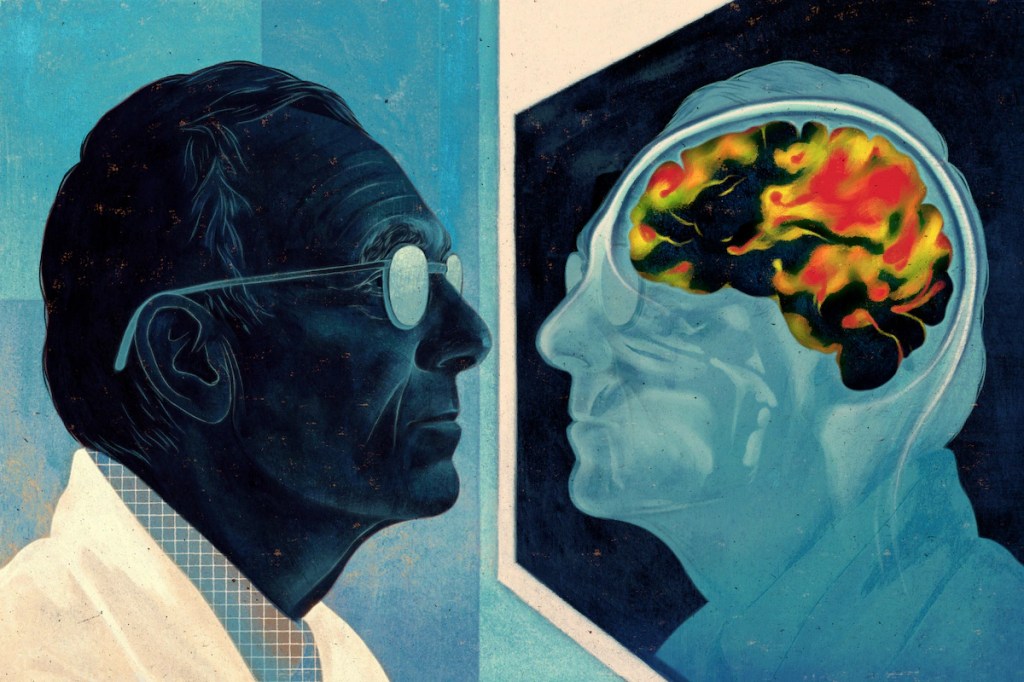
I had a PET scan as part of a research study, which showed my brain had the beginning of abnormal tau protein, a key part of diagnosing Alzheimer’s. When the scans were repeated in 2018 and 2022, the tau protein can be seen spreading through my brain.
We now know that the first signs of Alzheimer’s disease, beta-amyloid plaques, can be seen in the brain up to 20 years before any cognitive changes. Tau-containing tangles start to form later, about two or three years before the onset of mild cognitive impairment. There is a variation in the speed of progression from mild impairment to full-blown dementia to death, probably about eight to 12 years on average.
I am now 73, and I have had mild cognitive impairment for roughly five years, followed by mild dementia for about four years. We don’t yet have a way to stop this progression, but what have I been doing to slow it?
There are lifestyle modifications that help, and they also decrease the likelihood of getting it in the first place.
Top among them is aerobic exercise. Multiple studies have shown up to a 50 percent reduction in the chance of getting Alzheimer’s disease for people who exercise regularly. The only group that doesn’t seem to benefit from exercise are those who already have dementia. The sooner you start, the better.
I started exercising daily in 2012 as soon as I learned that I was on the Alzheimer’s trajectory. Recent evidence shows that tai chi can help people who already are experiencing cognitive impairment.
The data for adopting a plant-based diet are almost as strong as exercise. I follow a variant of the Mediterranean diet called the MIND diet that includes eating foods with increased flavonols such as nuts and certain vegetables. Many experts now recommend avoiding alcohol, especially for people with a family history of dementia. Recently, I gave up my daily glass of beer or wine. Frankly, I have been surprised that nonalcoholic beer tastes quite good.
Staying mentally active is very important. For me, my most important brain exercise is reading and writing. I do a crossword puzzle every day while eating lunch, and I enhance the brain benefit by looking up words I don’t know. Staying socially engaged is important but increasingly difficult as dementia progresses. It’s best for me to socialize with just one or two people at a time. Getting at least 7½ hours of sleep each night appears to reduce the chance of getting dementia.
What about drugs? We now have two FDA-approved drugs, lecanemab and donanemab, that are effective in removing beta-amyloid from the brain, but they only slow cognitive decline by about 35 percent. They can also have lethal side effects in patients with two copies of the APOE-4 allele, like me. After only four monthly injections of aducanumab (a cousin of lecanemab) during the phase 3 trial, I developed swelling and bleeding in my brain requiring a stay in an intensive care unit and about four months to recover. The drug has since been discontinued by its manufacturer.
These treatments represent an important step forward in understanding the neurobiology of Alzheimer’s disease, but they should not be used by everyone.
So I have learned that Alzheimer’s disease is not the rapidly progressive dementia I was taught about in medical school. It is a slowly progressive disease that is asymptomatic for up to 20 years. Mild symptoms of cognitive impairment may be annoying but usually can allow normal activities for another five years or so. Even work may be possible with accommodations. Once someone has dementia, unable to live independently, lifestyle modifications and medications do not seem to be as effective. In my experience, it is critical to manage Alzheimer’s disease in the early stages to postpone the onset of dementia. Don’t wait for the horses to get out of the barn.
Over the past few years, I’ve had the privilege of getting to know Sarah McBride through my role as President of the Medical Society of Delaware. She is truly extraordinary – a remarkable blend of intelligence, compassion, and genuine commitment to public service. Her decision to run for Congress was inspiring, and I am proud to stand among the many Delawareans who enthusiastically supported her candidacy.
The recent attacks by Congresswoman Nancy Mace are not just disappointing, but deeply troubling. Instead of engaging in substantive policy discussions that matter, her tactics represent a cynical approach that undermines the democratic process. Real leadership is about solving problems, building understanding, and bringing people together – not spreading misinformation or engaging in personal attacks.
I remain hopeful that Americans will see through these divisive tactics and recognize the true leadership qualities that Sarah McBride embodies. Our democracy is strongest when we elevate substantive dialogue and elect representatives who genuinely care about making a meaningful difference in people’s lives.
This program should be expanded and not eliminated!
“Senate and House Republicans told Peter Sullivan of Axios that if they regain control of the government, they will work to get rid of the provision in the Inflation Reduction Act that permits the government to negotiate with pharmaceutical companies over drug prices.
Negotiations on the first ten drugs, completed in August, will lower the cost of those drugs enough to save taxpayers $6 billion a year, while those enrolled in Medicare will save $1.5 billion in out-of-pocket expenses.”
Try Coffee Planking “Every morning I get up and make coffee for my wife and me. One cup takes one minute 18 seconds to brew, and every morning for the last 12 months I have planked for this period. Simple thing, using the dead time.”
Sort out your life! 100 tiny tricks to help with everything from digital overwhelm to lumpy sugar and unpaid bills
Here is a look at where Ms. Harris stands on healthcare policy issues
1. Reproductive health rights are likely to be a cornerstone of Ms. Harris’ campaign, according to KFF Health News.
2. Mergers and Acquisitions: Ms. Harris strongly opposed healthcare consolidation and prosecuted numerous industry players for alleged fraud or antitrust violations, according to The New York Times.
3. Ms. Harris proposed her own “Medicare for All” plan. In a departure from Mr. Sanders, the proposal called for a 10-year phase-in period and would allow private insurers to compete with a government-led system.
4. Ms. Harris has advocated for student loan debt forgiveness during her time as California attorney general and as vice president, particularly for those working in public service sectors such as education, law enforcement and healthcare.
5. Ms. Harris has advocated for investments to address the nation’s maternal health crisis and reduce health inequities. In 2022, she unveiled the administration’s Blueprint for Addressing the Maternal Health Crisis.
6. In April, Ms. Harris announced two final rules that set minimum staffing requirements for long-term care facilities and at-home services, and require facilities to have a registered nurse on site 24/7.
The general election campaign has commenced, spotlighting President Biden and former President Trump as the presumptive nominees for their respective parties and the currently viable contenders for the presidency. While this is not an election like in the past where health care reform is a central issue being debated, health care is an important issue for voters and Biden and Trump have sharply divergent records and positions. This side-by-side analysis serves as a quick resource for understanding each candidate’s record as president, positions, public statements, and proposed policies. It will be continuously updated as new information and policy details emerge throughout the campaign.
The headset is already changing disabled users’ lives.
In her childhood bedroom, Maxine Collard had a PC connected to a cathode-ray tube monitor so massive it bowed her desk into a smile that grew deeper every year. Collard has oculocutaneous albinism, which means that her hair is naturally bleach white, her complexion maximally fair, and she has uncorrectably low visual acuity with limited depth perception. In order to see the screen, she had to crane her neck until her face was two inches from the monitor.
When Collard was in middle school, her mother bought an iMac for the family. Collard spent hours messing around on the new machine, her nose pressed almost to the glass. One day, deep in the computer’s accessibility settings, she discovered that if she held down the control key while spinning the mouse’s scroll wheel, she could instantaneously zoom the entire screen to whatever magnification level she wanted. There was a rudimentary magnifier app on her Windows computer, but she found the interface difficult to use, and the low-res image on the zoomed-in PC screen, she said, was pixelated, hard to read, “disgusting.” Her experience on the iMac, which allowed her to magnify the entire screen into a much clearer image, came as a revelation.
Earlier this year, Collard had a similar aha moment when she tried theApple Vision Profor the first time. Some critics of the AVP were skeptical of a device that pressed two high-resolution micro-OLED screens within millimeters of one’s eyes for hours at a time. But to Collard, the ability to (as she put it) “strap an iPad to my face” was instantly appealing.
I Have a Rare Disease That Makes Me See Demon Faces Everywhere. It’s, Uh, Not Fun.
Maggie McCart…suffers from an extremely rare disease called prosopometamorphopsia, which inflicts patients with a variety of wild hallucinations when they look at someone’s face.
If you were to look through McCart’s eyes, you’d experience a world where faces appear to be made of tree bark, or are unnaturally contorted, or, perhaps, completely swapped out with a mythical creature. We asked McCart how she manages to live life while looking through a fun-house mirror.
Prosopometamorphopsia is sometimes referred to as “demon face syndrome.” Nobody knows what causes it—generally the disorder is linked with various brain traumas—and for a long time, I couldn’t get a diagnosis myself. My early interactions with doctors weren’t helpful. Years ago, I explained my symptoms to a neurologist. I reported what I was seeing, and they scanned my brain and didn’t find anything suspicious. The neurologist said something like, “Well, there’s nothing wrong with your brain.” And I thought, “I beg to differ.” But again, it’s not like they can see through my eyes. It’s not a simple situation, like asking a doctor to investigate a rash on your skin.
So for most of my life, I did my best to ignore the symptoms and go about my day. I learned to recognize people by their shoes, or their clothes, or the way they walked.




 CNMRI: Neurology, Sleep Medicine, MRI