Category Archives: Healthy Hints

Medical Mysteries: A new mother is felled by ferocious back pain

While breastfeeding her new baby, she developed intense, unexplained pain that kept getting worse.

Several days after her parents’ departure Lucido stumbled into the bathroom early one morning and unintentionally sat down hard on the toilet. Instantly she felt a sickening shudder in her lower back followed by the sensation of an electric current shooting up her spine. Intense nausea came next. Worried she might pass out from the pain, Lucido lay on the bathroom floor.

Aimee Lucido with her baby, Lyra

In 2018 Columbia University’s Irving Medical Center had launched a program headed by endocrinologist Adi Cohen to recruit, study and treat women with a rare condition called pregnancy- and lactation-associated osteoporosis (PLO).

A severe form of early-onset osteoporosis — osteoporosis that occurs before age 50 — PLO can occur in the late stages of pregnancy or during breastfeeding when the loss of maternal calcium leads to a temporary decrease in bone mineral density. Unlike postmenopausal osteoporosis, which is common and affects about 10 million Americans, PLO is rare, although no one knows how rare.

Little is known about the condition, which was described more than 70 years ago. Misdiagnosis is common and many doctors have never seen a case.

https://www.washingtonpost.com/health/2024/06/22/pregnancy-backpain-breastfeeding-medical-mysteries/

Apple Vision Pro Game Changer for Disabled

The headset is already changing disabled users’ lives.

In her childhood bedroom, Maxine Collard had a PC connected to a cathode-ray tube monitor so massive it bowed her desk into a smile that grew deeper every year. Collard has oculocutaneous albinism, which means that her hair is naturally bleach white, her complexion maximally fair, and she has uncorrectably low visual acuity with limited depth perception. In order to see the screen, she had to crane her neck until her face was two inches from the monitor.

When Collard was in middle school, her mother bought an iMac for the family. Collard spent hours messing around on the new machine, her nose pressed almost to the glass. One day, deep in the computer’s accessibility settings, she discovered that if she held down the control key while spinning the mouse’s scroll wheel, she could instantaneously zoom the entire screen to whatever magnification level she wanted. There was a rudimentary magnifier app on her Windows computer, but she found the interface difficult to use, and the low-res image on the zoomed-in PC screen, she said, was pixelated, hard to read, “disgusting.” Her experience on the iMac, which allowed her to magnify the entire screen into a much clearer image, came as a revelation.

Earlier this year, Collard had a similar aha moment when she tried the Apple Vision Pro for the first time. Some critics of the AVP were skeptical of a device that pressed two high-resolution micro-OLED screens within millimeters of one’s eyes for hours at a time. But to Collard, the ability to (as she put it) “strap an iPad to my face” was instantly appealing.

See Link for more:

https://nymag.com/intelligencer/article/apple-vision-pro-disabled-users.html

Body mass index or BMI Falling out of favor

Body mass index was first developed in 1832 and has been the standard way to estimate a person’s body fat since the 1980s. The calculation, however, has come under increasing scrutiny in recent years.

One major critique of BMI is that it doesn’t look at how much of a person’s weight is fat, and where fat is distributed around the body. It also doesn’t take into account the other elements that make up a person’s body composition beyond fat, including muscle, bone, water and organs.

“Fat distribution and body composition can vary dramatically among different people with the same BMI,” Wenquan Niu, a professor at the Capital Institute of Pediatrics in Beijing, wrote in an email.

Because muscle is much denser than fat, BMI skews higher in people who are very muscular but have less body fat, like athletes https://www.nbcnews.com/health/health-news/bmi-flaws-body-roundness-index-better-rcna155898

Healthy diet, exercise, slow decline in Alzheimer’s

A healthy diet and consistent exercise may slow decline in some early-stage Alzheimer’s disease patients, according to research published Friday. 
The study, published in the journal Alzheimer’s Research and Therapy, found that patients in a group who implemented “intensive” lifestyle changes — like eating whole foods, exercising moderately and performing stress management techniques — saw their dementia symptoms stabilize. In the other group, patients who did not alter their habits found their thinking and memory continued to worsen https://thehill.com/policy/healthcare/4711200-diet-exercise-may-slow-decline-in-some-alzheimers-patients-study/

Over The Counter Hearing Aids

These WIRED-tested and audiologist-approved devices will help you hear sounds more clearly. Never miss out on a dinner conversation again.

“FOR THOSE WITH hearing challenges, there’d long been just one option for dealing with it: an expensive, bulky hearing aid prescribed by a doctor. That changed in 2022 when the US Food and Drug Administration approved over-the-counter hearing aid devices, giving consumers access to a vast and growing array of alternatives.

Today, there are more hearing aids than ever, and they come in all different shapes, sizes, and most importantly, prices. How does a $100 hearing aid compare to a $5,000 prescription device for treating mild to moderate hearing loss? We’ve been testing products for the past two years to answer that question.”

https://www.wired.com/gallery/best-hearing-aids/

A breakthrough in Alzheimer’s disease

A breakthrough in Alzheimer’s disease The promising potential of klotho

I have this dream that people might be able someday to benefit from klotho, this factor that naturally circulates in our body, that helps with longevity, that helps with other organ systems and enhances the brain.” —Dena Dubal

Dena Dubal is a physician-scientist and professor of neurology at UCSF whose work focuses on mechanisms of longevity and brain resilience. In this episode, Dena delves into the intricacies of the longevity factor klotho: its formation and distribution in the body, the factors such as stress and exercise that impact its levels, and its profound impact on cognitive function and overall brain health. Dena shares insights from exciting research in animal models showing the potential of klotho in treating neurodegenerative diseases as well as its broader implications for organ health and disease prevention. She concludes with an optimistic outlook for future research in humans and the potential of klotho for the prevention and treatment of Alzheimer’s disease.

#303 – A breakthrough in Alzheimer’s disease: the promising potential of klotho for brain health, cognitive decline, and as a therapeutic tool for Alzheimer’s disease | Dena Dubal, M.D., Ph.D.

Why Medicare Advantage is not an Advantage

Prior authorization issues and the quest for profits are major issues with many Medicare Advantage plans, as outlined in this article.

“Traditional Medicare rarely requires so-called prior authorization for services. But virtually all Medicare Advantage plans invoke it before agreeing to cover certain services, particularly those carrying high price tags, such as chemotherapy, hospital stays, nursing home care and home health.

“Most people come across this at some point if they stay in a Medicare Advantage plan,” said Jeannie Fuglesten Biniek, associate director of the program on Medicare policy at KFF, the nonprofit health policy research organization. After years of steep growth, more than half of Medicare beneficiaries are now enrolled in Advantage plans, which are administered by private insurance companies.”

Get Ready for Summer Heat Wave

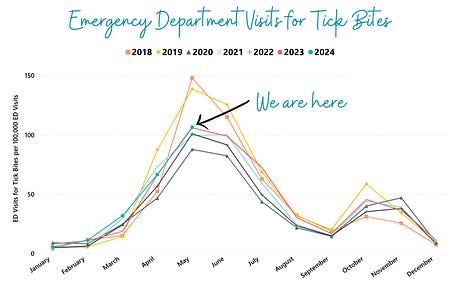
This summer is slated to be a hot one, which means more risk to population health. Last summer, emergency room visits for heat-related illnesses reached an all-time high

The National Oceanic and Atmospheric Administration (NOAA) and CDC created a health risk score taking into account temperature, humidity, and other metrics that impact health. The risk score ranges daily from “No risk” to “Extreme” heat risk.

More here, from my favorite epidemiologist
https://yourlocalepidemiologist.substack.com/p/state-of-affairs-may-23

Tick Bite Season is Here

Warm weather and lush spring vegetation are perfect for ticks to multiply. Ticks carry multiple diseases, especially Lyme, which is endemic in Delaware. Lyme disease often causes flu-like symptoms if it gets systemic along with neurologic and cardiac complications, especially if it becomes chronic.

Protect yourself from ticks by using products containing DEET or picaridin, treating clothing and gear with permethrin (watch out for allergies to this stuff) and carefully checking for ticks after outdoor activities (may need to get near naked 🙂

More details from my favorite epidemiologist https://yourlocalepidemiologist.substack.com/p/state-of-affairs-may-23

Botox for Trigeminal Neuralgia

There is a growing body of evidence suggesting that Botox is a safe and effective treatment for trigeminal neuralgia.

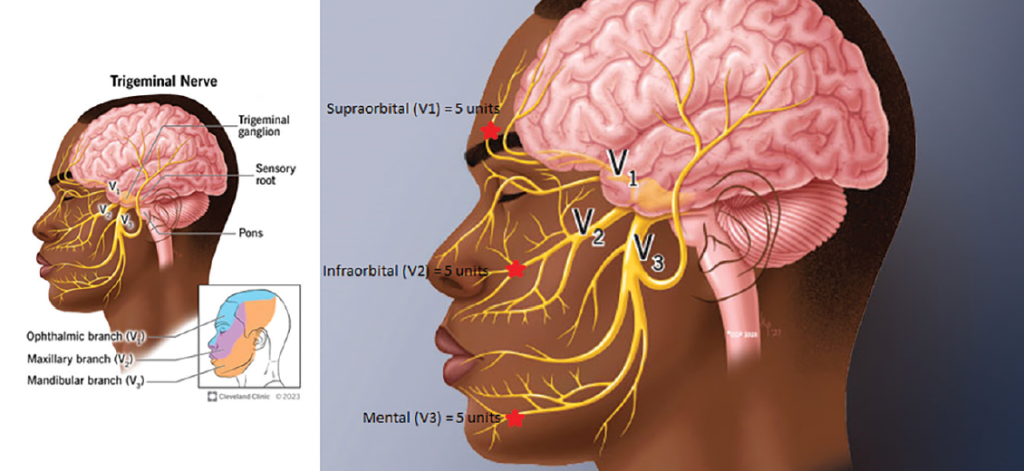
Trigeminal neuralgia (TN) is a chronic facial pain disorder characterized by sudden, severe, electric shock-like pain in one or more branches of the trigeminal nerve. This condition is relatively rare, with about 4.3 new cases per 100,000 people each year in the US.

TN can significantly impact quality of life, often leading to higher rates of depression, anxiety, and sleep disorders compared to the general population. Common triggers like brushing teeth, chewing, and swallowing can be so painful that individuals may neglect oral hygiene, lose weight, become dehydrated, and develop anxiety about these activities. TN can be highly disabling, with up to 45% of sufferers missing daily activities for at least 15 days in six months, and over 50% experiencing severe anxiety and depression related to their pain.

Trigeminal Neuralgia Treatment

The first line of treatment for TN usually includes anticonvulsant medications such as carbamazepine, oxcarbazepine, lamotrigine, gabapentin, lacosamide, or the muscle relaxant baclofen. However, these drugs often have side effects like fatigue, cognitive issues, dizziness, tremors, and electrolyte imbalances, which can limit their use. For acute pain flares, treatments like infusion therapy and trigeminal nerve blocks are used.

Surgical options for classic TN include microvascular decompression, gamma knife radiosurgery, and balloon compression, but these come with concerns about tolerability, long-term efficacy, and safety.

Botox for Trigeminal Neuralgia Treatment

Botox, also known as OnabotulinumtoxinA, FDA-approved for chronic migraine, is used off-label by neurologists for TN. Small studies have shown that it can be a safe and effective treatment, particularly for those who cannot tolerate medications or are not candidates for surgery. This treatment has been shown to reduce pain intensity and attack frequency and improve quality of life compared to a placebo.

Speak with your CNMRI neurologist about this treatment if you are having break through facial pain from TN in spite of multiple medication trials.

https://practicalneurology.com/articles/2024-may-june/onabotulinumtoxina-for-trigeminal-neuralgia-treatment