Tag Archives: dementia

Home Care Resources

Are there programs in Delaware that will allow me to hire my own attendant?
https://dhss.delaware.gov/dsaapd/faq_attendant.html

Can I get paid for being a caregiver for a family member or friend?
https://dhss.delaware.gov/dsaapd/faq_attendant2.html

Delaware Division of Aging Contact Information
Phone: 1-800-223-9074
Email: DelawareADRC@delaware.gov

https://dhss.delaware.gov/dsaapd/contact.html

Long Term Care Medicaid Programs
https://dhss.delaware.gov/dmma/ltcmedicaid.html

Medicaid and veterans programs can help alleviate the financial burden of family caregiving
https://www.aarp.org/caregiving/financial-legal/info-2017/you-can-get-paid-as-a-family-caregiver.html

★ Delaware Medicaid & Medical Assistance

Understanding Long-Term Care Insurance
https://www.aarp.org/caregiving/financial-legal/info-2021/understanding-long-term-care-insurance.html

Long-Term Care Cost Calculator
https://www.aarp.org/caregiving/financial-legal/long-term-care-cost-calculator/?cmp=RDRCT-672c8608-20210611

Seven Simple Ways to Reduce your risk of Dementia

The latest research is revealing clues about how you might be able to lower your chances of getting dementia. Here’s what the science says about keeping your mind sharp

  1. Keep your eyes on the move (and hearing)
  2. Keep on learning
  3. Surround yourself with others
  4. Be conscientious, not neurotic
  5. Reduce your exposure to air pollution
  6. Make sleep your priority
  7. Exercise and eat healthy

Click the link for more details
https://apple.news/ApqEPmWXwQ9ymdNIrQ7TM3g

DMV Reporting Laws Update

Delaware finally amended its DMV reporting laws to no longer require mandatory reporting of patients with seizures, loss of consciousness or other medical conditions.

Physicians should continue to use their medical judgment when dealing with patients with potentially impaired driving capabilities and may continue to send reports to DMV on a case by case basis.

House Bill 314, which updates the outdated mandatory reporting requirements for loss of consciousness due to a central nervous system condition, was supported by MSD and had passed both chambers. On Friday, August 2nd, Governor Carney signed the legislation into law.

MSD President, Robert Varipapa, MD, testified that the mandatory reporting system did not function effectively, especially in the emergency room setting where individuals are often inappropriately reported to the Division of Motor Vehicles (DMV) resulting in overworked DMV personnel and a substantial backlog in the physician’s office. 

It was also noted that the mandatory reporting requirement placed physicians in the awkward role of being a law enforcement officer, leading some patients being hesitant to truthfully disclose seizures or other episodes of loss of consciousness to their physician due to fear of losing their license. 

MSD testimony stated that physicians and other medical professionals should still report cases to the DMV based on medical evidence, not only limited to repeated loss of consciousness, but also other conditions such as dementia and stroke. 

This Act does all of the following: 

(1) Allows for all licensed practitioners (physician, nurse practitioner, or physician assistant) who are treating a driver for a medical condition to report findings and sign Division paperwork, which mirrors verbiage found in Title 24; 

(2) Updates the name of Medical Council to Board of Medical Licensure and Discipline which ensures compliance with code in handling of individual cases; and 

(3) Changes the Secretary of Health and Social Services to Secretary of Transportation for determining the status of driver’s license for individuals with a potential medical condition which allows for quicker response and ensures the confidentiality of a driver. Lastly it removes a section from the Medical Licensure Act consistent with the other provisions of the bill.

A vaccine that could lower dementia risk has been hiding in plain sight

Why the vaccine may protect against dementia

Offit and other experts said there are two possible reasons that the shingles vaccine might protect against dementia. First, previous research suggests that herpes infection might play a role in the development of dementia.

Shingrix dramatically decreases the reactivation of the herpes virus that causes chickenpox. It’s 97 percent effective at preventing shingles in people ages 50 to 69 with healthy immune systems, according to the CDC.

Experts also hypothesize there might be something about the particular way Shingrix stimulates the body’s immune system against shingles that decreases the chances of dementia.”

https://www.washingtonpost.com/wellness/2024/07/30/shingles-vaccine-lower-dementia-risk/

Another very expensive drug for Alzheimer’s disease with lots of side effects and unclear benefit

FDA OKs Another Drug for Early Alzheimer’s Disease

The FDA approved donanemab (Kisunla) for the treatment of adults with early symptomatic Alzheimer’s disease with confirmed amyloid pathology, the agency announcedopens in a new tab or window Tuesday. This includes Alzheimer’s patients with mild cognitive impairment and mild dementia.

The once-monthly treatment is the only anti-amyloid agent with evidence to support stopping therapy when amyloid plaques

https://www.medpagetoday.com/neurology/alzheimersdisease/110934

Alzheimer’s blood test catches 90% of early dementia

In the new study, the p-tau217 test was combined with another blood biomarker for Alzheimer’s called the amyloid 42/40 ratio, which measures two types of amyloid proteins, another biomarker of Alzheimer’s disease.

https://www.cnn.com/2024/07/28/health/alzheimer-blood-test-p-tau-217-wellness/index.html

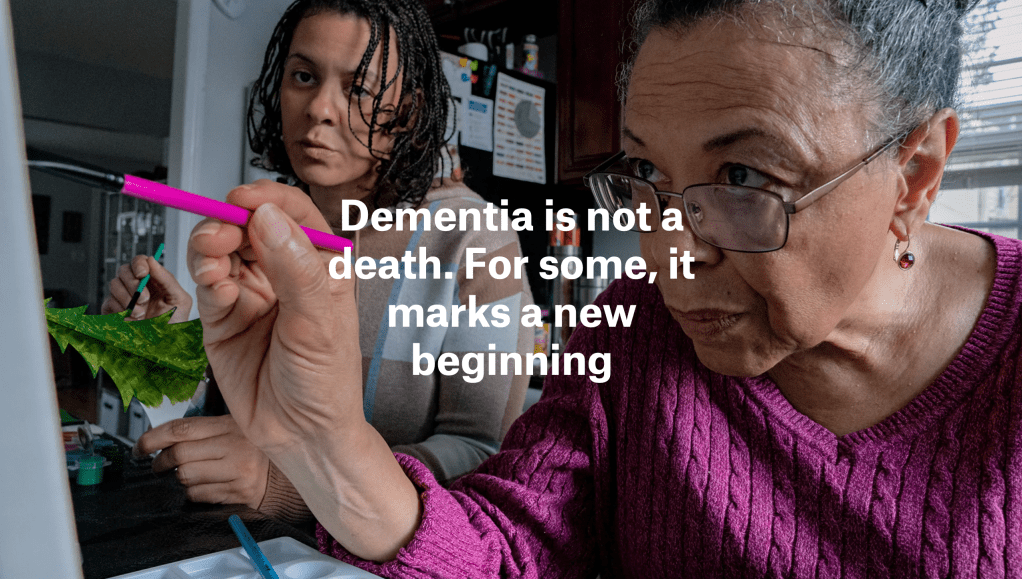
Dementia is not a death

For some, it marks a new beginning

Advocates are reframing the syndrome as a different way of being – one in which potential for growth and connection endures

They argue that dementia is not a hopeless affliction, and that post-diagnostic support should become more humane and scientific. Some are even calling for the condition to be completely reimagined.

One patient, quoted in the dementia expert John Zeisel’s book ‘I’m Still Here’ goes so far as to describe it as ‘a new stage in a wonderful life, no less challenging or interesting than all the earlier stages’.

https://psyche.co/ideas/dementia-is-not-a-death-for-some-it-marks-a-new-beginning

New Drug Approved for Early Alzheimer’s

The Food and Drug Administration on Tuesday approved a new drug for Alzheimer’s disease, the latest in a novel class of treatments that has been greeted with hope, disappointment and skepticism.

The drug, donanemab, to be sold under the brand name Kisunla, was shown in studies to modestly slow the pace of cognitive decline in early stages of the disease. It also had significant safety risks, including swelling and bleeding in the brain.

Kisunla, made by Eli Lilly, is similar to another drug, Leqembi, approved last year. Both are intravenous infusions that attack a protein involved in Alzheimer’s, and both can slow the unfolding of dementia by several months. Both also carry similar safety risks. Leqembi, made by Eisai and Biogen, is given every two weeks; Kisunla is given monthly.

Kisunla has a significant difference that may appeal to patients, doctors and insurers: Lilly says patients can stop the drug after it clears the protein, amyloid, which clumps into plaques in the brains of people with Alzheimer’s.

“Once you’ve removed the target that you’re going after, you then can stop dosing,” said Anne White, an executive vice president of Lilly and president of its neuroscience division. She said that this could reduce the overall cost and inconvenience of the treatment as well as the risk of side effects.

Do we have Alzheimer’s disease all wrong?

“As Science noted in its story on the retracted paper, scientists are still debating whether the amyloid theory is viable. The skeptics cite the fraudulent research and lack of a genuine breakthrough; supporters can point to this new class of drugs including donanemab that have led to some improvement in some patients.”

https://www.vox.com/future-perfect/355108/alzheimers-disease-drug-approval-research-retraction

Two Is Better Than One in the Alzheimer’s Market

“Last week, a panel of independent advisers to the FDA unanimously voted in support of Eli Lilly’s donanemab, a competitor in the same class of drugs that target amyloid plaques in the brain. The FDA is expected to decide on whether to approve the drug by the end of the year.

Life expectancies around the world have surged in recent decades, increasingly putting people at risk of dementia. About one in nine seniors has Alzheimer’s disease, the most common cause of the condition, which works out to some seven million Americans.”

https://finance.yahoo.com/news/two-better-one-alzheimer-market-110000384.html